
Living with Diabetes
Easing the Burden of Managing Diabetes with Dexcom CGM
Published: Aug. 25, 2026
10 min read
People living with diabetes are responsible for prioritizing diabetes management and looking after their health alongside all the commitments, obligations, and activities that are a regular part of life. It’s estimated that those living with diabetes make about 180 decisions about their health every day—which means they’ve got a lot on their minds!1
It’s important to acknowledge that managing diabetes can impact your mental health, not just your physical health. Keeping up with the demands of diabetes management or navigating challenges along your diabetes journey can affect your quality of life and sense of well-being. Creating diabetes management habits that fit your needs and lifestyle can play a role in supporting your mental health, too. Using tools like a continuous glucose monitoring (CGM) system can help reduce the mental burden of managing diabetes every day.
Understanding the unique demands of diabetes management
People living with diabetes have to pay attention to details that others who don’t live with the condition likely never think about. This includes aspects of diabetes management like:
- Carefully considering how choices you make—like running to catch your bus or enjoying a snack—will impact your glucose.
- Worrying about experiencing low glucose throughout the day and while you’re asleep.
- Balancing your insulin doses with your carb intake and activity level.
- Counting the amount of carbs in your meal before you take a bite.
- Planning your schedule so that you can eat and give yourself insulin at regular intervals throughout the day.
- Budgeting to cover the costs of diabetes medication and supplies.
Checking your glucose levels and making careful decisions all the time requires a lot of focus and consistency, even when you’ve got a lot on your plate. Experiencing diabetes complications or not reaching your glucose management goals can leave you feeling discouraged or even hopeless. Facing stigma or judgment from the people in your life around your diabetes management can leave you feeling isolated when you need understanding and support the most. Recognizing that managing diabetes is challenging can help you be more compassionate towards yourself. It can also give you a sense of pride in the fact that you continue to show up to face those challenges to the best of your ability, whatever that may look like for you.
Diabetes distress and burnout: When the burden of diabetes is too much
Feeling overburdened by diabetes can lead to what’s known as diabetes distress. Diabetes distress can include experiencing negative emotions like anger or fear around diabetes and feeling like diabetes management takes up too much of your energy.2,3 Dealing with diabetes distress over an extended period of time can lead to diabetes burnout.3,4 When someone experiences burnout, they no longer feel motivated to engage in their usual diabetes management routines. They may skip doctor’s appointments or stop paying attention to their diet and exercise routine.3 Burnout often happens when a person is working as hard as they can, putting in consistent effort, but without seeing results from their diabetes management routine.3,4
If you’re concerned that you’re experiencing diabetes distress, you may want to fill out Diabetes Canada’s Diabetes Distress Scale questionnaire to check in with how you’re feeling.
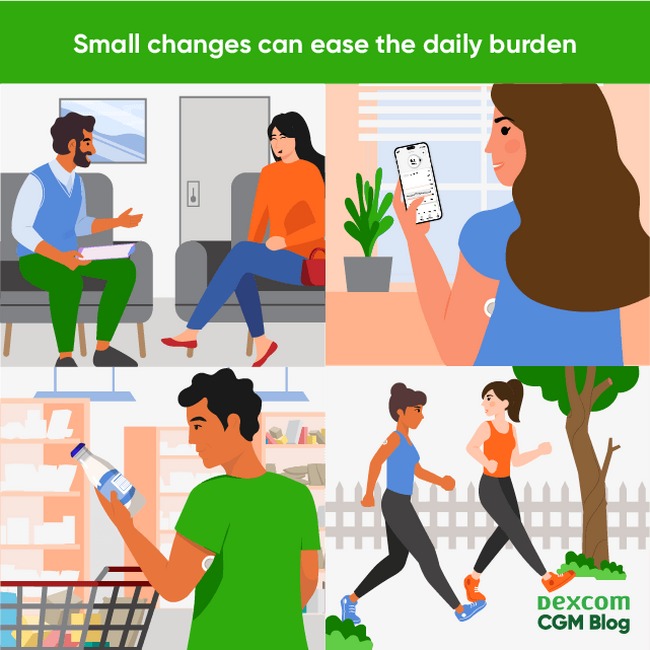
Even though taking action is the very thing that feels the most difficult when you’re going through diabetes distress or burnout, small, practical adjustments can help ease the burden of diabetes management. It’s a good idea to get in touch with your diabetes care team so that you can talk about making adjustments to your treatment plan to make it more manageable. This could include working with a diabetes dietitian to better tailor your diet to your taste or exploring new physical activities that get you connected to others—like a fitness class or walking group. It can also include discussing how technology, like a CGM system, can make daily glucose monitoring and decision-making a little less overwhelming.
How Dexcom CGM can reduce the burden of managing diabetes
A CGM system like Dexcom G7 can help simplify glucose monitoring, making it easier to take informed action to manage your glucose in the moment so that your diabetes routines fit more seamlessly into your everyday life. Here are a few ways using Dexcom G7 can reduce some of the mental load of living with diabetes and help you get ahead of diabetes distress and burnout.
Experience greater peace of mind around knowing where your glucose is headed
Worrying about whether you’re at risk of hypoglycemia, low glucose, or hyperglycemia, high glucose, or experiencing fear around going low—known as fear of hypoglycemia—can be stressful. Getting real-time insight into where your glucose levels are and where they’re headed can help you catch important changes so you can take proactive action, giving you a little extra peace of mind when making glucose management decisions.
Dexcom G7 uses technology called an algorithm to predict whether your glucose levels are likely to go up or down. You can see what’s happening with your glucose at a glance with the Dexcom G7 app on your compatible smartphone or smartwatch, or your handheld receiver.* Dexcom G7 is the only CGM system that can provide a predictive alert that can let you know up to 20 minutes before you’re likely to experience a low under 3.1 mmol/L, giving you extra time to prevent lows before they happen.5† The built-in Low Glucose alert notifies you the moment your glucose drops below 3.1 mmol/L. With glucose readings in the palm of your hand, you’re empowered to make informed decisions that help you keep your glucose within your ideal range in the moment.
Set up proactive notifications so you can focus on doing what matters most
One of the main benefits of using a CGM system is that it can provide alerts that let you know when you need to take action to manage your glucose. This can lighten the mental load of having to constantly check your readings and worrying about experiencing highs or lows when you’re occupied during a busy day, having fun with loved ones, or trying to get a good night’s sleep. Having control over what alerts you receive, how often you get them, and the way your notifications sound helps you ensure alerts support your glucose management routines, without disrupting your day.
With Dexcom G7, you can fully customize your glucose alerts to stay in the know, without the notification fatigue. In addition to the Urgent Low Soon and Low Glucose alerts, you can set your own high and low glucose alerts with thresholds that reflect your ideal glucose range. You can silence all your notifications for up to six hours or set them to vibrate only. If you set alerts to silent or vibrate, the Low Glucose alert will still sound out loud if you don’t acknowledge the initial notification, so you’re less likely to miss lows if they happen. You can also create a schedule so that your alerts sound when it makes sense—like when you’re driving—and are set to silent or vibrate if you need to be more discreet—such as during work, meetings, or classes.
See what’s working in your diabetes management routine and build confidence
When you’re juggling the demands of managing diabetes on a daily basis, it’s not always easy to see whether your hard work is paying off.
Dexcom G7 doesn’t just provide insight into what’s happening with your glucose levels day-to-day, it can also help you understand how your diabetes management plan is working overall. The Trends tab in the Dexcom G7 app provides important glucose metrics like your average time in range (TIR), your glucose management indicator—an approximation of your A1C—and your insulin usage trends, and shows you your glucose patterns over time.
Reviewing these metrics can give you a better idea of how your decisions and habits impact your diabetes management, making it easier to tailor your routines to meet your needs. It also gives you the chance to look at the big picture of your glucose management so you can see how far you’ve come and celebrate milestones along the way. When you have a window into how your choices and habits impact your glucose management goals, you can feel more confident about your diabetes management decisions going forward.
Stay connected to your circle of support
Involving trusted caregivers and loved ones in your diabetes management plan can make taking care of yourself feel a little lighter. For example, experimenting with diabetes-friendly recipes with your family or getting some movement in by going for regular walks with friends makes engaging in healthy habits more fun and fulfilling.
Allowing loved ones to support you with glucose monitoring, when it’s appropriate, can also give you a greater sense of freedom. You can link the Dexcom G7 app to the Dexcom Follow app, which allows up to 10 people to view your glucose readings and get glucose alerts remotely on their own compatible smart device.* With Dexcom Follow, your circle of support can keep an eye on your glucose levels if you need it—like when you’re sick or during a demanding workweek. Knowing that someone else will be notified about significant changes in your glucose levels can help you feel more at ease as you go about your busy day, especially if you work or live by yourself.
Those who use the Follow app to share their glucose readings with caregivers and loved ones feel greater peace of mind and experience less worry around hypoglycemia. Having one or more Followers can help you spend more time in your ideal range.6 For children and teens living with T1D, having at least one Follower is associated with spending more time in range and reducing hypoglycemia and hyperglycemia.7,8
Explore how Dexcom G7 can help you live well with diabetes
Dexcom G7 can provide a real-time view into what’s happening with your glucose so you can take proactive action in the moment and check in to see how your decisions impact your glucose as you move through your day. When you can see how your diabetes management plan is working, you can work with your care team to make adjustments and ensure your routines fit your needs. With insights into your glucose patterns over time, you can track your progress and celebrate your hard work every step of the way.
* Smart devices sold separately. For a list of compatible smart devices, please visit www.dexcom.com/compatibility.
† This predictive alert can be triggered with impending hypoglycemia (glucose of 3.1 mmol/L or below is predicted to occur within the next 20 minutes).
1 Robinson DJ, et al. Can J Diabetes. 2023;47(4):308-344.
2 Diabetes Distress Scale. Diabetes Canada. 2015. Accessed March 5, 2026. https://www.diabetes.ca/managing-my-diabetes/tools---resources/diabetes-distress-scale
3 Distressed by diabetes. Diabetes Canada. May 15, 2024. Accessed March 5, 2026. https://www.diabetes.ca/about-diabetes/impact-stories/distressed-by-diabetes
4 What is diabetes distress and burnout? Diabetes UK. Accessed March 5, 2026. https://www.diabetes.org.uk/living-with-diabetes/emotional-wellbeing/diabetes-burnout
5 Dexcom data on file, 2026.
6 Derdzinski M, et al. Diabetologia. 2019: S391-S2.
7 Welsh JB, et al. Diabetes Ther. 2019;10(2):751-755.
8 Welsh JB, et al. Diabetes Technol Ther. 2019;21(3):128-13.