

Caffeine is a chemical found in coffee, tea, soda, and energy drinks that stimulates the nervous system, making us feel more awake and energetic.1 Even though most of us consume caffeine casually on a daily basis, it’s technically a psychoactive drug—meaning that it can change the way our brains function.2 In fact, it’s the most widely used drug across the world!1 Because caffeine can have a powerful effect on the body, it’s important to be mindful of how consuming caffeine fits into your diabetes management routine.
How does caffeine affect diabetes management?
Doctors and researchers are still working to understand whether there’s a connection between caffeine and blood sugar, or glucose, management and long-term glucose regulation in those living with diabetes.
Studies in people not living with diabetes suggest that when people who don’t usually consume caffeine start drinking caffeinated beverages, they may temporarily experience lower insulin sensitivity.3 However, the body quickly adapts, and regular coffee drinking doesn’t appear to affect overall insulin sensitivity.3 Another study of people not living with diabetes revealed that both caffeinated and decaffeinated coffee may help reduce insulin resistance, leading to a decreased risk of developing type 2 diabetes (T2D).4 This effect might be connected to a compound in coffee that stimulates the secretion of glucagon-like peptide-1 (GLP-1), which helps support insulin’s role in glucose regulation.5
Studies of people living with T2D who drink two to four cups of coffee a day are less likely to experience cardiovascular disease and chronic kidney disease, which are common diabetes complications.5 Drinking coffee may also reduce inflammation in the body, which can make it easier for the body to use and regulate glucose.4
While it’s not clear whether caffeine has a direct effect on diabetes in general, caffeine does have a proven impact on the way your body works, which can influence your glucose management.
Caffeine and cortisol
When we feel stressed over a long period of time, known as chronic stress, cortisol works to keep glucose levels high so that we have the energy we need to deal with the perceived threat.6 Caffeine can raise cortisol levels significantly, especially if you don’t drink caffeine very often.7 If cortisol spikes after you’ve consumed caffeine, your glucose levels may go up, too.8 Over time, many people develop a tolerance for caffeine and they stop experiencing dramatic increases in cortisol.7
Be aware that not everyone’s body adapts to caffeine the same way. Consuming caffeine can also increase the risk of experiencing anxiety or make anxiety worse.8 On top of negative mental health effects that can impact your well-being, dealing with anxiety or chronic stress may decrease insulin sensitivity and make it more challenging for the body to use glucose.8,9
It’s a good idea to keep an eye on how caffeine affects you on a day-to-day basis: some regular caffeine drinkers may notice no change in their glucose patterns. A continuous glucose monitoring (CGM) system like the Dexcom G7 CGM System gives you a real-time view into your glucose levels, so you can see how your morning pick-me-up impacts your glucose management.
Caffeine, sleep, and glucose management
It’s especially important for people living with diabetes to consider how their caffeine consumption affects their sleep. Sleep plays a major role in glucose regulation in the body as well as mental health—both of which can also impact diabetes management and your overall sense of well-being.10
The whole point of drinking caffeine is to reduce fatigue and feel energized. Caffeine works by blocking a chemical called adenosine that gradually builds up during our waking hours to make us feel sleepy at the end of the day.11 This can perk you up and help keep you focused and alert as the day goes on, but it can also make it harder to fall—and stay—asleep.11 Even if you only consume caffeinated drinks in the morning, their effects can linger into the evening. It can take between two and 12 hours for just half of the caffeine you’ve consumed to leave your body, so you could still feel wired when you head to bed.11
Not getting enough high-quality sleep can make it more challenging to manage your glucose levels. Falling asleep later at night and waking up throughout the night are associated with glucose spikes after breakfast.12 Changing your sleep schedule and going to bed later than usual can impact the way the body regulates glucose throughout the following day.12 Poor sleep quality can decrease insulin sensitivity, which means the body has trouble using insulin to absorb the glucose in the blood.10,13 Studies show that not getting enough sleep keeps glucose levels high in older adults living with T2D.12 Sleep is also connected with the production of the stress hormone cortisol. A lack of sleep can increase cortisol, leading to elevated glucose.6,14
Dawn phenomenon and caffeine
Some people living with diabetes experience high blood sugar right when they wake up in the morning, before they eat any carbs.15,16 This is known as dawn phenomenon.13,14 Dawn phenomenon causes a cortisol spike, usually between 3 am and 8 am that can spike glucose levels.14 If you experience dawn phenomenon, it might be smart to time your caffeine consumption accordingly, as drinking coffee can also contribute to raising cortisol levels.7,8
What to consider when choosing your brew
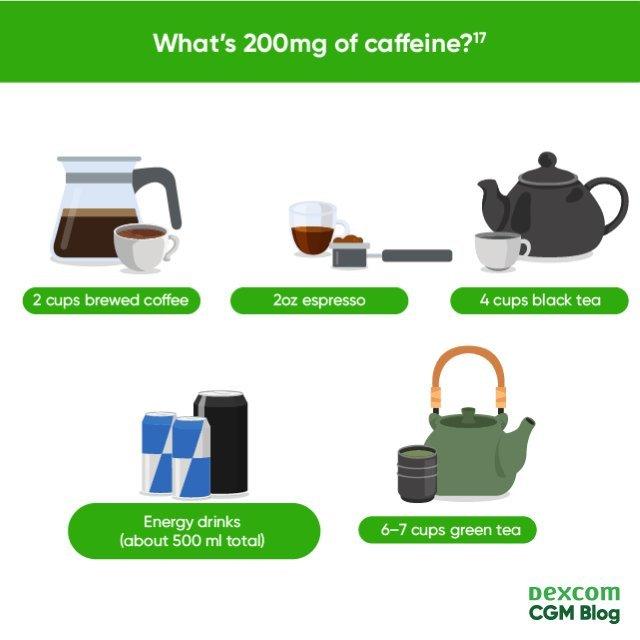
It’s a good idea to talk to your doctor and diabetes care team about whether caffeine fits into your diabetes management plan and whether it supports your overall health. In general, drinking about 200 mg of caffeine per day is enough to keep you feeling refreshed without unwanted side effects. You can get 200 mg of caffeine from:17
- About two cups of brewed coffee
- Two ounces of espresso
- Around four cups of black tea
- Between six and seven cups of green tea
- Two Red Bull (250 ml), or one Monster Energy (500 ml)
Canada recently capped the amount of caffeine in energy drinks to 180 mg per serving in response to the serious health effects high-caffeine beverages can have on drinkers, especially teens.18,19 Consuming over 600 mg of caffeine may cause issues like shaking, high blood pressure, and a racing heartbeat. It can also leave you feeling irritable, restless, or nervous and make it hard to fall asleep.20
It’s smart to stay mindful about what you’re putting in your coffee or tea. Even if you’re not planning to add a spoonful of sugar to your beverage, be aware that lactose in milk is converted into glucose in the body and plant milks may have added sugar that can impact your glucose levels.21 Other additions like sweetened condensed milk, bottled coffee creamer, and non-dairy creamer, or coffee whitener, typically contain added sugar as well.
Specialty drinks from your favourite café, like lattes and cappuccinos, as well as chai or matcha lattes, and London Fogs—Earl Grey tea usually made with vanilla syrup—may contain extra carbs and calories. Flavoured coffees and tea lattes are usually sweetened with sugary syrups. Be sure to take this into account when calculating insulin doses.
Find out how caffeine affects your glucose with Dexcom G7
Caffeine affects everyone differently, and it can even affect your blood sugar in different ways depending on the day. The best way to determine how caffeine impacts your diabetes management is to check in with your glucose readings on a regular basis. You can log the caffeinated drinks you consume alongside your glucose readings right inside the Dexcom G7 app on your compatible smartphone.* This gives you insight into whether your morning cup of joe causes changes in your glucose in the moment. You can look back to see whether drinking caffeine continues to impact your glucose over the course of the day. With glucose readings in the palm of your hand, you’re empowered to make proactive choices about habits like drinking caffeine so you can manage diabetes with greater confidence.
* Smart devices sold separately. For a list of compatible smart devices, please visit www.dexcom.com/compatibility.
Sources
1 Evans J, et al. In: StatPearls [Internet]. Treasure Island (FL): StatPearls Publishing; 2025 Jan–. National Center for Biotechnology Information, U.S. National Library of Medicine. https://www.ncbi.nlm.nih.gov/books/NBK519490/
2 Definition of Psychoactive Substance. NCI Dictionary of Cancer Terms. National Cancer Institute. Accessed January 16, 2026. https://www.cancer.gov/publications/dictionaries/cancer-terms/def/psychoactive-substance
3 van Dam RM, et al. N Engl J Med. 2020;383(4):369-378.
4 Reis CEG, et al. J Tradit Complement Med. 2018;9(3):184-191.
5 Liu YJ, et al. Nutrients. 2023;15(18):3910.
6 Kaur J, et al. Physiology, Cortisol. In: StatPearls [Internet]. Treasure Island (FL): StatPearls Publishing; 2025 Jan-. National Center for Biotechnology Information, U.S. National Library of Medicine. Accessed January 16, 2026. https://www.ncbi.nlm.nih.gov/books/NBK538239/
7 Lovallo WR, et al. Psychosom Med. 2005;67(5):734-739.
8 Is caffeine making you anxious? 5 things to know. UCLA Health. Accessed January 16, 2026. https://www.uclahealth.org/news/article/caffeine-making-you-anxious-5-things-know
9 Stress and diabetes. Diabetes UK. Accessed January 16, 2026. https://www.diabetes.org.uk/living-with-diabetes/emotional-wellbeing/stress
10 Hussain N, et al. Sleep Med X. 2025;9:100139.
11 Fountain L, Cotliar D. Caffeine and Sleep. Sleep Foundation. Accessed January 16, 2026. https://www.sleepfoundation.org/nutrition/caffeine-and-sleep
12 Tsereteli N, et al. Diabetologia. 2022;65(2):356-365.
13 Tiwari R, et al. Prim Care Diabetes. 2021;15(4):635-641.
14 Cortisol: What It Is, Function, Symptoms & Levels. Cleveland Clinic. Accessed January 16, 2026. https://my.clevelandclinic.org/health/articles/22187-cortisol
15 The dawn phenomenon: What can you do? Mayo Clinic. Accessed January 16, 2026. https://www.mayoclinic.org/diseases-conditions/diabetes/expert-answers/dawn-effect/faq-20057937
16 Dawn Phenomenon. Cleveland Clinic. Accessed January 16, 2026. https://my.clevelandclinic.org/health/diseases/24553-dawn-phenomenon
17 Caffeine content for coffee, tea, soda and more. Accessed January 16, 2026. https://www.mayoclinic.org/healthy-lifestyle/nutrition-and-healthy-eating/in-depth/caffeine/art-20049372
18 Caffeinated energy drinks. Health Canada. Accessed January 16, 2026. https://www.canada.ca/en/health‑canada/services/food‑nutrition/supplemented‑foods/caffeinated‑energy‑drinks.html
19 Link, C. Health Canada caps caffeine in energy drinks, 28 companies forced to reformulate. Accessed January 16, 2026. https://www.newhope.com/regulatory/health‑canada‑caps‑caffeine‑in‑energy‑drinks‑28‑companies‑forced‑to‑reformulate
20 Substance Use: Caffeine. Accessed January 16, 2026. Alberta Health Services. https://myhealth.alberta.ca/alberta/pages/Substance-use-caffeine.aspx
21 Hantzidiamantis PJ, et al. Physiology, glucose. In: StatPearls. StatPearls Publishing: Updated April 30, 2024. Accessed August 7, 2025. https://www.ncbi.nlm.nih.gov/books/NBK545201/