
Real User Stories
How Malcolm Kelly manages type 2 diabetes with Dexcom CGM
Published: Sep. 11, 2026
Updated: Sep. 21, 2026
5 min read
The content in this article should not be taken as medical advice. Please consult with your healthcare provider regarding your individual health needs.
Malcolm Kelly is a force of nature. He used his six-foot-five frame to his advantage playing rugby for 30 years, so he’s no stranger to taking a few hits and pushing through the obstacles in his path. When Malcolm was diagnosed with type 2 diabetes (T2D) at 47, he discovered a new kind of inner strength that would reshape his relationship with his health, and himself.
Committing to healthy choices every day and using a Dexcom Continuous Glucose Monitoring (CGM) System to guide his decisions empowered Malcolm to tackle his diabetes management goals head-on. For Malcolm, managing type 2 diabetes is a source of pride. He’s become an advocate for people living with T2D, openly sharing his story in the hopes that others will be inspired to keep showing up for themselves along their own diabetes journey.
Navigating a life-changing type 2 diabetes diagnosis
Malcolm is no stranger to T2D. His family has a history with the condition, and both his mother and grandmother lived with T2D. Malcolm has also built a career in healthcare, working in pharmaceutical sales and marketing roles where he has encountered many people living with diabetes.
Two years before his diagnosis, Malcolm started noticing symptoms he knew could be related to diabetes. “I dealt with the frequent urination, headaches, and feeling tired at all hours of the day,” says Malcolm. “I knew exactly what was going on, but I was in denial.” Malcolm put off seeking a diagnosis until he could no longer manage his symptoms. Malcolm experienced a number of high and low blood sugars and hesitated to check his blood sugar by pricking his finger. “Like a lot of men, I thought I could just handle what was going on myself,” he says.
After receiving his T2D diagnosis, Malcolm faced a painful wave of negative emotions. “When you get diagnosed with diabetes, it’s life-altering. I don’t think we acknowledge the gravity of the diagnosis the way we do with other diseases like cancer,” Malcolm says. “The doctor told me something that profoundly changed my life, and before I knew it, I was sitting in my car with a prescription, by myself. I thought my life was over. I was so worried that there were already underlying health issues I didn’t know about.”
“Even though I had a family history of T2D, I still felt ashamed after my diagnosis. I didn’t want to tell my friends or colleagues about my diagnosis because I didn’t want them to tell me it was my fault, because I felt like it was my fault.”
Malcolm found himself grappling with his self-esteem and feelings of isolation and helplessness. “Even though I had a family history of T2D, I still felt ashamed after my diagnosis,” he says. Malcolm was hesitant to share his T2D diagnosis with anyone, including his wife, Kim, who has been his partner since they were in high school. “I didn’t tell her right away because I was so disgusted with myself,” he says. “I didn’t want to tell my friends or colleagues about my diagnosis because I didn’t want them to tell me it was my fault, because I felt like it was my fault.”
His perspective started to shift after a phone call with his mom. “I told her my A1C was 8.4 and she said, ‘You’re a diabetic.’ I knew I had to fix it, I understood the consequences if I didn’t take action,” he says. “I decided at that moment that I was going to change my trajectory.”
Sitting in his car before heading into the gym for a workout one day, Malcolm took a simple step that would change his entire relationship with diabetes management. “I was fairly emotional, I wasn’t feeling my best, and I took a video of myself, telling myself how I was feeling,” he recalls. “Unbeknownst to me at that moment, it was probably one of the single best things I could have done. It changed my life. Whenever I am tempted to ignore my healthy habits or I feel discouraged, I watch that video. It would give me a visceral reaction and reinforce the choices I was making.”
Committing to a new way of thinking about food
Having played rugby for 30 years, Malcolm was already very physically active and worked out regularly. He began his diabetes management journey by shifting his eating habits. Rather than adopting a strict diet, he reflected on his food choices and committed to making small changes. This started with “zero-sugar” days, avoiding refined sugars and carbs like bagels, pasta, and rice.
Paying attention to what he was eating and how his choices impacted his health transformed the way he thinks about food. “I developed a conscious relationship with food that I never had in my entire life,” he says. “I found that I was choosing better options and leaving carbs aside. Now, I see food as fuel and my choices about what I eat are no longer subconscious.” This new approach enabled Malcolm to lose 35 lbs., improve his A1C, and experience meaningful health gains, from lower cholesterol to more energy and mental clarity, giving him the confidence to keep going.
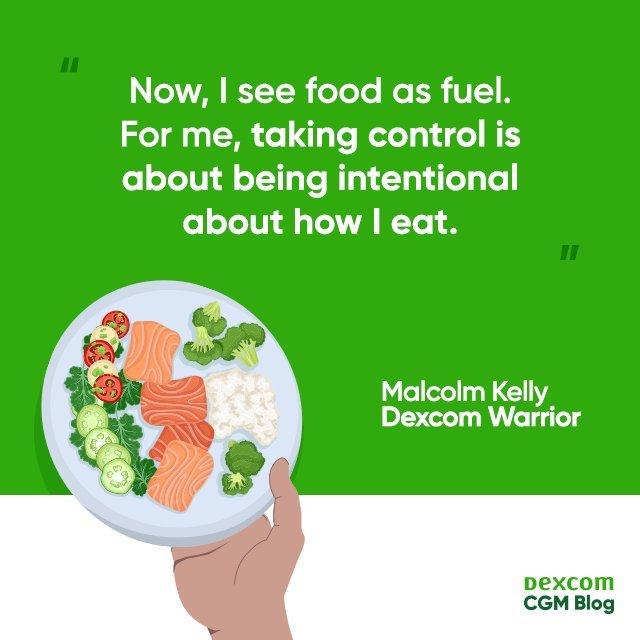
Malcolm still enjoys the foods he loves while maintaining a balanced diet that’s right for him. “When people get a diabetes diagnosis, they think that they’ll only be able to eat broccoli for the rest of their life,” he says. “You do have to change the way you eat, but you also have to embrace your preferences and then take the time to understand what you’re putting into your body and how it affects your blood sugar. It doesn’t mean you can’t have a burger. For me, taking control is being intentional about those choices.”
Finding a better way to see how habits have an impact
Even though Malcolm was making healthy choices, he was struggling to see how they were impacting his glucose management goals because he wasn’t taking blood sugar readings. “I had a blood glucose monitor (BGM), but I never used it. I couldn’t do it. I would have to get my wife to do it for me,” he says. “I hated it. It was painful and time-consuming. I didn’t want to get calluses. I would do it once a week, but once a week became never.”
At the time, Malcolm knew that CGM systems existed, but he didn’t think they were an option for people living with T2D. Malcolm finally tried the technology when his wife started working for Dexcom. His first Dexcom CGM system was a game-changer, giving him greater insight into his glucose levels than he ever thought possible—without the need for uncomfortable routine fingersticks.* “The first time I put a Dexcom CGM on, I looked down at my phone and I was amazed that you could see the readings in real time,” he says. “I’d eat a bowl of ice cream and see the line on the glucose graph go up and then go down. I could see how everything affected my levels.”
Owning diabetes management with Dexcom CGM
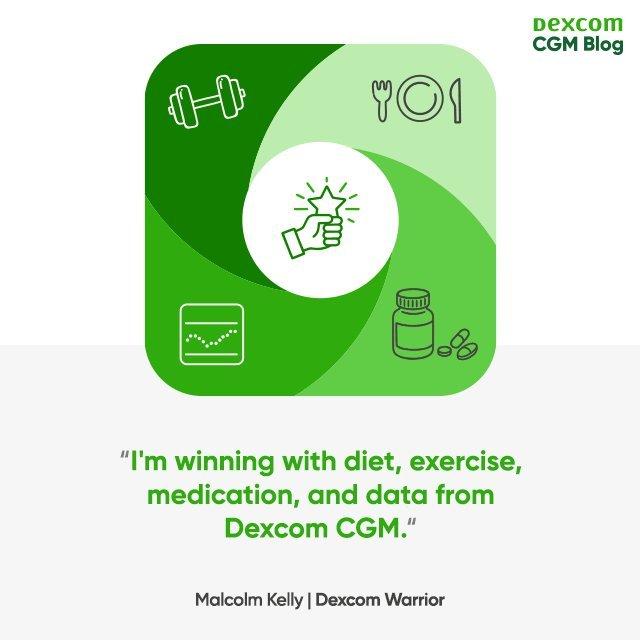
After switching to a Dexcom CGM system, Malcolm gained a new sense of empowerment and control over his disease. With glucose readings in the palm of his hand on his compatible smart device,† he could use data to support his intentional food choices, see how his glucose changed throughout the day, and get a view into how his healthy habits contributed to his diabetes management goals. “When you start to take ownership of yourself and your health, that’s when you’re truly in control,” Malcolm says. “I feel like it’s me against diabetes, and I’m winning right now. There’s no other choice for me. I’m winning with diet, exercise, medication and data from my Dexcom CGM.”
Looking to further improve his diabetes management, Malcolm got onto a GLP-1 medication, helping him lose an additional 45 lbs. With the right medication, intentional diet and exercise habits, and data from Dexcom CGM to back his decision-making, Malcolm has been able to achieve his health goals. “Never in my wildest dreams did I think I could have this much control over T2D. My endocrinologist essentially fired me as a patient; she doesn’t need to see me anymore,” Malcolm says. “My A1C is 5.4, my cholesterol is incredible, and I’ve been able to sustain my weight loss for over three years now.”‡
Malcolm’s Dexcom CGM is an integral part of his daily routine, from the gym to the takeout counter at his favourite coffee shop. “With Dexcom, I can go as deep into the glucose data as I want or quickly check my readings,” he says. “When I’m not feeling great, it’s easy to see if it’s my glucose causing it. When I’m feeling good, I can check to see what decisions and factors contributed to that.”
“My A1C is 5.4, my cholesterol is incredible, and I’ve been able to sustain my weight loss for over three years now.”
Malcolm uses his Dexcom CGM as both a guide and a cheerleader. Looking back at his glucose readings gives Malcolm the chance to celebrate his strength and discipline, while continually learning what’s working for him and what isn’t. “Seeing my glucose readings just reinforces all the work that I’ve done and all the work I continue to do,” he says. “It reinforces how proud I am to be a diabetic who is in control of the disease.”
Crushing the stigma around being a person living with diabetes
Through his diabetes journey, Malcolm has fully embraced his identity as a person living with diabetes and has become an outspoken advocate for others living with T2D. “I am proud to say that I am a diabetic,” Malcolm says. “If I’m at the coffee shop, I’ll tell them, ‘Can I get a coffee with two sweeteners, and can you make sure there’s no sugar in it, because I’m diabetic.’ I’m not afraid to let people know because there is no shame in being a type 2 diabetic.”
Having overcome his own internalized stigma, he wants others to understand that the disease is an illness that develops for reasons outside of a person’s control. “Most people think T2D is a condition that’s related to your lifestyle; it doesn’t get the same level of empathy as cancer or heart disease. People think that if you’re obese, it’s because you’re lazy and you don’t work out or eat very well—that being overweight is a choice,” Malcolm says. “I played rugby at a high level for 30 years. We had practice two times a week and played a game every week. I was training at the gym five or six days a week. I also played hockey. I wasn’t sedentary, I did an incredible amount of exercise and I was still 320 lbs.”
“I am proud to say that I am a diabetic. I’m not afraid to let people know because there is no shame in being a type 2 diabetic.”
As a father of two boys, 23 and 19, with aspirations of playing professional football, he hopes to model healthy habits and show them that while a diabetes diagnosis might be life-changing, it’s nothing to be ashamed of.
Explore how Dexcom CGM can support your type 2 diabetes journey
With a Dexcom CGM system like Dexcom G7, you can see where your glucose is at and where it’s headed in the moment, so you can make proactive decisions to help you stay in your ideal glucose range. Dexcom G7 is proven to help those with T2D improve glucose management and lower their A1C.1–5 When you have insight into what’s happening with your glucose, you can see how your routines and decisions impact your levels and celebrate every win along the way.
* Fingersticks required for diabetes treatment decisions if symptoms or expectations do not match readings.
† Smart devices sold separately. For a list of compatible smart devices, please visit www.dexcom.com/compatibility.
‡ Individual results may vary.
1 Beck RW, et al. JAMA. 2017;317(4):371-378.
2 Beck RW, et al. Ann Intern Med. 2017;167(6):365-374.
3 Martens T, et al. JAMA. 2021;325(22):2262-2272.
4 Laffel LM, et al. JAMA. 2020;323(23):2388-2396.
5 Welsh JB, et al. J Diabetes Sci Technol. 2024;18(1):143-147.