
Vivant avec le diabète
Vivre avec le diabète : conseils essentiels liés au mode de vie
Publié: Jun. 3, 2025
Mis à jour: Aug. 27, 2026
12 temps de lecture
Le contenu de cet article ne doit pas être considéré comme un avis médical. Veuillez consulter votre professionnel de santé pour toute question relative à vos besoins individuels en matière de santé.
L'éducation est un outil précieux lorsque l'on vit avec le diabète. Ce guide vous aidera à en savoir plus sur les meilleurs aliments pour contrôler la maladie, sur la façon de rester physiquement actif et sur le lien entre la santé mentale et le diabète.
Points à retenir
- Vous n'êtes jamais seul dans votre parcours avec le diabète. De nombreuses ressources sont à votre disposition, notamment votre équipe soignante et les communautés locales du diabète.
- Il est tout à fait possible de profiter des choses que vous aimez et de vivre des expériences agréables lorsque vous vivez avec le diabète.
- Pour gérer le diabète en toute confiance, vous pouvez notamment adopter une alimentation saine, pratiquer une activité physique, prendre soin de votre santé mentale et trouver une communauté.
- Les ressources éducatives, les conseils d'autogestion et les témoignages d'autres personnes atteintes de diabète peuvent vous aider à gérer la maladie.
Bien vivre avec le diabète
La gestion du diabète est un travail exigeant qui demande beaucoup d'énergie, d'attention et de courage 24 h/24, 7 j/7. Vivre avec le diabète peut parfois sembler accablant, mais sachez que vous n'êtes jamais seul dans votre parcours avec la maladie. Il existe de nombreux outils éducatifs, de ressources de soins de santé, d'options technologiques pour le diabète et de systèmes de soutien communautaire pour vous aider à gérer la maladie ainsi qu'à mener une vie active et épanouissante.
L'expérience du diabète est unique à chaque personne, et découvrir ce qui fonctionne pour vous et pour votre corps est un processus continu. Une partie importante de la gestion du diabète est l'autogestion, qui comprend les habitudes, les routines et les choix que vous faites chaque jour pour favoriser votre bien-être. Le diabète est une maladie complexe et de nombreux facteurs ont une incidence sur sa gestion. Parmi ceux-ci, citons notamment l'alimentation, l'activité physique, le sommeil et la santé mentale. Il n'est pas toujours facile de maintenir l'équilibre entre toutes ces variables, alors soyez indulgent envers vous-même. Vous informer sur la gestion du diabète peut vous aider à comprendre la maladie et à vous sentir plus en confiance dans la prise en charge de votre santé au fur et à mesure que vous avancez dans votre parcours avec le diabète.

Adopter une approche holistique de la gestion du diabète
Vivre sainement avec le diabète, c'est se sentir le mieux possible le plus souvent possible tout en réduisant le risque de complications liées à cette maladie. L'un des aspects les plus importants de la gestion du diabète est de surveiller votre glycémie, également appelée le glucose1. Un taux de glucose élevé ou bas peut avoir des répercussions sur votre état de santé et votre bien-être général. À long terme, les problèmes liés au glucose peuvent entraîner d'autres troubles tels que des lésions nerveuses ou des maladies cardiaques; c'est pourquoi il est essentiel de maintenir un taux de glucose sain pour être en bonne santé2.
Le contrôle du glucose est influencé par les processus qui se déroulent dans votre corps ainsi que par les circonstances de votre environnement. La diaTribe Foundation a identifié au moins 42 facteurs pouvant influer sur votre taux de glucose. Outre l'activité physique et l'alimentation, les changements hormonaux, la santé intestinale et même la météo peuvent avoir une incidence sur la régulation du glucose dans l'organisme . Adopter une approche holistique de la gestion du diabète signifie prêter attention à la manière dont ces nombreux éléments interdépendants influent sur la gestion de votre glucose et votre bien-être général.
Gérer le diabète grâce à la mesure du glucose
Il n'est pas facile de comprendre ce qui provoque les variations de votre taux de glucose. L'un des moyens d'obtenir plus d'informations sur vos modèles glycémiques consiste à utiliser un système de surveillance continue du glucose (SCG). Les systèmes de SCG, tels que le système de SCG Dexcom G7, fonctionnent en envoyant les valeurs du glucose directement depuis un capteur portable vers un appareil intelligent compatible ou un récepteur, et ce, toutes les cinq minutes maximum*. Cela signifie que vous n'avez pas besoin d'effectuer des prélèvements capillaires de routine pour obtenir vos valeurs du glucose†.
Les systèmes de SCG peuvent fournir beaucoup plus de valeurs du glucose que vous ne pourriez en obtenir à l'aide d'un lecteur de glycémie. Un plus grand nombre de valeurs du glucose vous permet de mieux visualiser les variations de votre taux de glucose, ce qui vous aide à identifier les variables qui pourraient avoir un effet. En fournissant des données détaillées sur votre taux de glucose à votre médecin et à votre équipe de soins du diabète, vous les aidez à établir les liens nécessaires pour identifier les problèmes sous-jacents et à vous orienter afin d'améliorer votre plan de traitement du diabète.
L'utilisation d'un système de SCG peut vous permettre de prendre des décisions immédiates liées au traitement et de mettre en œuvre des changements qui pourraient avoir des effets positifs durables. Il a été démontré que les systèmes de SCG Dexcom aident les personnes à réduire considérablement leur taux d'HbA1c, à diminuer l'hypoglycémie et à passer plus de temps dans leur plage de glucose cible (généralement définie par Diabète Canada comme étant comprise entre 3,9 et 10,0 mmol/L )5-9.

Alimentation saine et diabète
Pour les personnes vivant avec le diabète, l'alimentation fait partie intégrante de la gestion de la maladie. Une alimentation équilibrée figure parmi les régimes recommandés pour le diabète de type 1 (DT1) et le diabète de type 2 (DT2), mais il n'existe pas de régime unique qui convienne à toutes les personnes atteintes de diabète.
Un diététicien spécialisé dans le diabète peut vous aider à élaborer un programme alimentaire personnalisé adapté. Il peut vous guider dans vos choix alimentaires et vous informer sur les aliments à éviter avec le diabète. La régularité est essentielle pour réguler le glucose, il est donc judicieux de trouver des aliments que vous aimez consommer quotidiennement et qui peuvent également vous aider à atteindre vos objectifs nutritionnels. L'utilisation d'une technologie telle que le système de SCG Dexcom peut vous aider à comprendre comment les aliments affectent votre taux de glucose afin que vous puissiez ajuster votre régime alimentaire en conséquence.
Bien qu'il existe un lien étroit entre une alimentation saine et la gestion du diabète, n'oubliez pas que de nombreux facteurs peuvent influer sur votre taux de glucose. Ce que vous mangez peut être tout aussi important que le moment où vous le faites. Par exemple, prendre des repas équilibrés au moins trois fois par jour peut aider votre corps à réguler votre taux de glucose. La combinaison des aliments dans vos repas influence également votre taux de glucose. Manger d'abord des fibres, puis des protéines et des graisses, puis des glucides peut aider à réduire les pics de glucose après les repas10.
Une alimentation saine repose sur la préparation. Diabète Canada recommande aux personnes vivant avec le diabète de planifier régulièrement leurs repas pour la semaine à venir. L'organisme propose de nombreux modèles de plans alimentaires liés au diabète que vous pouvez utiliser pour commencer.
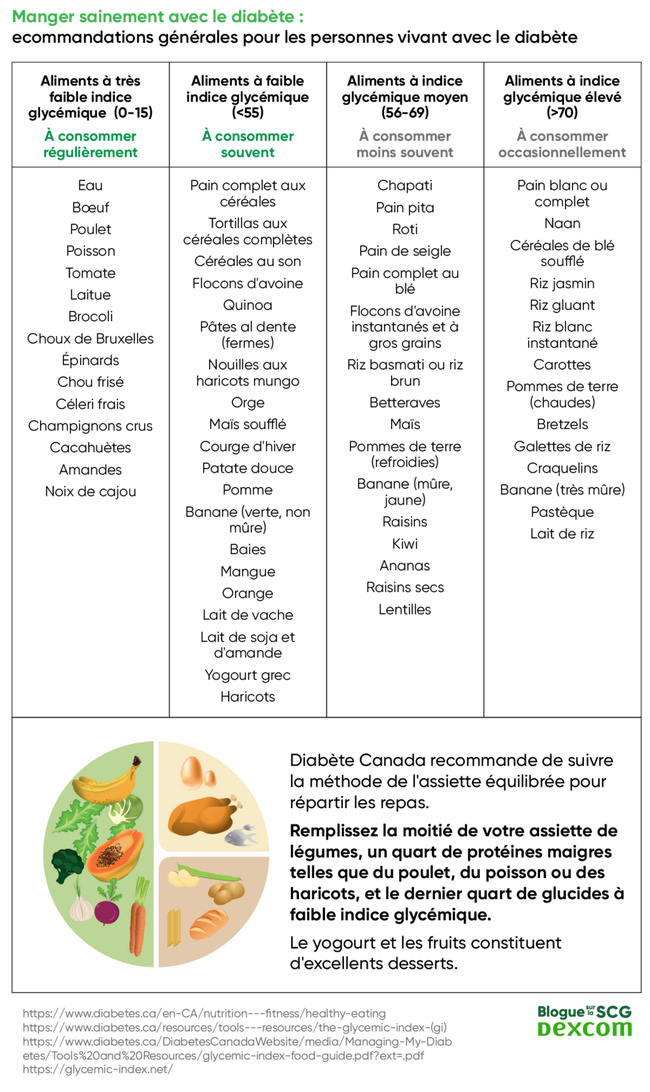
Lorsque vous élaborez votre régime pour le DT1 ou le DT2, il est utile de vous familiariser avec l'indice glycémique (IG). L'IG classe les aliments sur une échelle de 1 à 100 selon la vitesse à laquelle ils augmentent la glycémie. Choisir plus souvent des aliments à faible IG, tels que les viandes maigres, légumes verts et noix, peut vous aider à maintenir votre taux de glucose dans la plage cible. Ils offrent également de grands avantages nutritionnels, en fournissant les vitamines et minéraux essentiels dont vous avez besoin pour rester en bonne santé lorsque vous vivez avec le diabète1,2. Certains aliments, comme les fruits, les galettes de riz et les céréales, peuvent être recommandés dans des régimes alimentaires populaires, mais certains ont un IG élevé. Vérifier l'IG des aliments que vous appréciez est judicieux pour s'assurer qu'ils vous aident à atteindre vos objectifs en gestion du glucose.
Il existe de nombreux aliments délicieux à faible IG que vous pouvez intégrer à votre régime pour le diabète. Consultez toujours votre médecin et votre diététicien spécialisé dans le diabète avant de modifier votre alimentation. Voici quelques exemples d'aliments recommandés pour gérer le diabète, ainsi que des aliments à éviter, fournis par Diabète Canada, pour vous aider à planifier vos repas.
Activité physique et diabète
L'activité physique peut vous aider à gérer votre taux de glucose, à réduire votre taux d'HbA1c et à améliorer votre bien-être général. Diabète Canada recommande aux personnes vivant avec le diabète de pratiquer au moins 150 minutes d'activité physique modérée au moins 3 jours par semaine, comprenant à la fois des exercices d'aérobie ou cardio et des exercices de résistance ou de musculation. Des recherches montrent que la combinaison d'exercices cardio et de musculation est plus efficace en termes d'efficacité pour réduire le taux d'HbA1c que la pratique d'un seul de ces types d'exercices . Chez les personnes vivant avec le DT2, il a été démontré que la musculation augmente la sensibilité à l'insuline13.
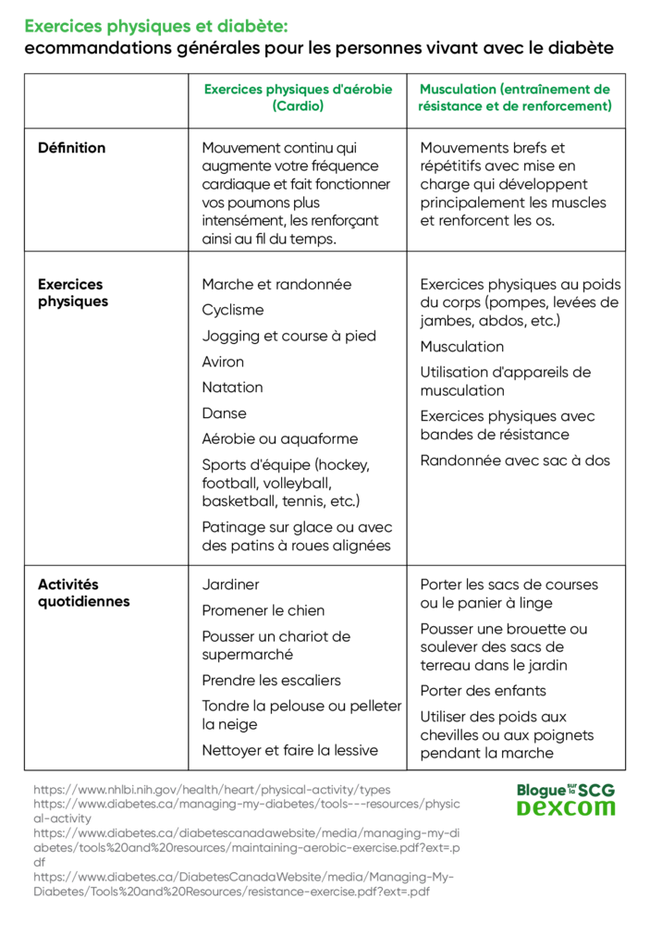
En matière d'activité physique et de diabète, chaque corps est différent. Il n'est pas nécessaire de s'entraîner de manière intensive pour profiter des bienfaits de l'activité physique. Tout comme l'alimentation, votre programme d'activité physique doit être adapté à vos besoins, à vos préférences et à vos capacités afin que vous puissiez en tirer le meilleur parti. Voici quelques conseils et informations pour vous aider à pratiquer en toute confiance une activité physique qui vous aidera à mieux gérer le diabète :
Gérez votre glucose lorsque vous êtes actif
Que vous commenciez tout juste à faire de l'activité physique ou que vous soyez déjà un adepte du sport, il est judicieux de discuter avec votre médecin de la gestion de votre taux de glucose pendant l'activité physique. Une activité physique intense peut provoquer une augmentation des hormones du stress, ce qui peut augmenter la glycémie à ce moment-là13. Lorsque nous pratiquons une activité physique, nos muscles peuvent absorber le glucose de la circulation sanguine sans avoir besoin d'insuline14. Cela peut rapidement faire baisser le taux de glucose, en particulier chez les personnes vivant avec le diabète qui utilisent de l'insuline. Une activité physique aérobique prolongée, comme la course à pied, la natation ou le vélo, peut contribuer à maintenir un taux de glucose bas pendant 24 heures ou plus15.
Intégrez des activités physiques agréables à votre quotidien
Rester actif peut être plus facile que vous ne le pensez. Faire le ménage, déneiger ou ratisser les feuilles, courir avec vos enfants ou vos animaux domestiques sont autant d'activités quotidiennes qui peuvent vous aider à mieux gérer votre glucose. Voici quelques autres idées simples et peu intenses que vous pouvez pratiquer tous les jours :
- Faire une promenade dans le quartier.
- Danser dans la cuisine avec votre famille.
- Porter vos sacs de courses.
- Prendre les escaliers ou monter les escaliers roulants.
- Ajouter de petits poids à vos poignets et à vos chevilles lors de vos étirements.
Vivre avec le diabète peut être une expérience difficile. Essayer des activités physiques organisées peut vous donner l'occasion de créer des liens avec votre communauté, de vous amuser et de vous défouler. Rejoignez une ligue de curling ou un club de tennis, rendez-vous à la patinoire locale pour jouer au hockey, inscrivez-vous à un cours de yoga ou rejoignez un groupe local de marche ou de jogging. Vous pouvez également essayer un cours de danse qui vous connecte à votre culture, comme la danse classique indienne, la danse philippine tinikling, la salsa colombienne, la danse folklorique ukrainienne ou la danse autochtone.
Faites participer les enfants à des activités physiques
Diabète Canada recommande que les enfants fassent au moins une heure d'activité physique chaque jour . Il existe de nombreuses possibilités pour faire participer les enfants vivant avec le diabète à des activités physiques amusantes. Jouer dans la cour, aller au parc, faire de la luge ou du patin sont d'excellents moyens de faire bouger les enfants. La communauté du diabète propose également de nombreux programmes permettant aux enfants vivant avec cette maladie de connecter entre eux tout en pratiquant une activité physique. Voici quelques organisations qui proposent des programmes pour les enfants et les jeunes :
- Camps D-Camps de Diabète Canada
- Camps de hockey DSkate
- Aventures I Challenge Diabetes
N'ayez pas peur de tenter de nouvelles aventures
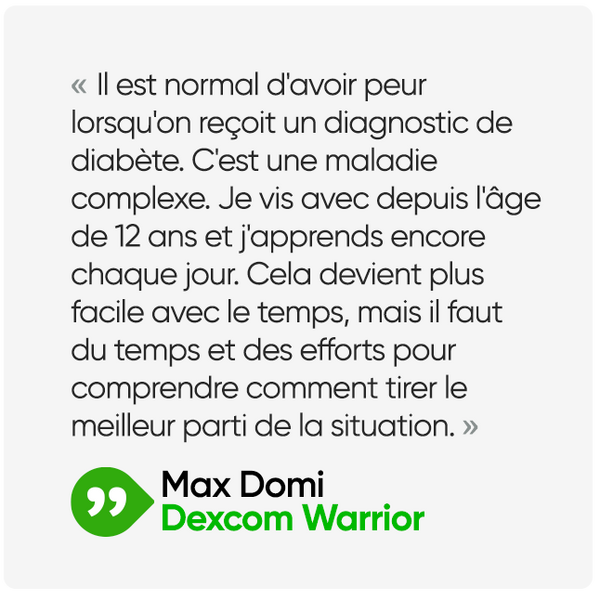
Il est tout à fait possible de gérer le diabète tout en pratiquant des activités physiques plus intenses comme les sports d'équipe de compétition, l'alpinisme, la course de fond ou les entraînements intensifs. Par exemple, Ben, un Dexcom Warrior, est un passionné d'escalade et se rend régulièrement dans les montagnes près de Vancouver pour passer la journée à escalader des falaises. Max Domi, un autre Warrior, a joué pour plusieurs équipes de la Ligue nationale de hockey (LNH) depuis 2011. La jeune Warrior Leena est une joueuse de tennis de haut niveau qui a représenté le Canada aux Championnats du monde juniors de tennis.
Il est recommandé d'informer votre médecin lorsque vous essayez de nouvelles activités. Il est également important de surveiller votre glucose lorsque vous repoussez vos limites. Les systèmes de SCG Dexcom peuvent faciliter la surveillance de votre taux de glucose, que vous vous entraîniez à la salle de sport, que vous fassiez une randonnée difficile ou que vous pratiquiez un sport de compétition. Si vous êtes prêt pour votre prochaine aventure, Connected in Motion propose des programmes de plein air pour les adultes vivant avec le DT1 qui combinent randonnée, canot, escalade et camping avec un soutien entre pairs et une éducation sur le diabète.
Santé mentale et diabète
La santé mentale et la gestion du diabète sont étroitement liées. La gestion du diabète peut être exigeante sur le plan physique et difficile sur le plan émotionnel. Il faut parfois beaucoup d'énergie pour rester discipliné, mesurer son taux de glucose et faire des choix sains en permanence. Les amis et les proches qui ne vivent pas avec le diabète ne comprennent pas toujours ce que vous vivez, ce qui peut créer un sentiment d'isolement.
Le chemin sinueux de la gestion du diabète n'est pas toujours facile, et il est normal de se sentir parfois déprimé lorsqu'on vit avec la maladie. Les personnes atteintes de diabète peuvent être plus susceptibles de souffrir de troubles mentaux tels que la dépression, l'anxiété et la détresse liée au diabète. En savoir un peu plus sur ces états d'esprit peut vous aider à reconnaître si vous en souffrez et vous donner les moyens de rechercher l'aide que vous méritez.
Gérer la détresse liée au diabète et l'épuisement
La détresse liée au diabète désigne un ensemble d'émotions différentes qui peuvent accompagner le fait de vivre avec cette maladie. Ces sentiments peuvent inclure l'inquiétude face aux complications du diabète ou la peur d'avoir un épisode d'hypoglycémie. La détresse liée au diabète peut également inclure un sentiment de frustration ou d'échec lorsque les efforts que vous avez déployés pour contrôler votre taux de glucose ne semblent pas avoir d'effet sur vos objectifs de gestion du diabète. Le stress lié aux relations interpersonnelles, comme le sentiment d'être incompris ou exclu, peut également contribuer à la détresse liée au diabète16,17 .
Souffrir de détresse liée au diabète ou lutter pendant longtemps pour gérer le diabète peut conduire à un épuisement. Ce dernier peut se traduire par le fait de ne plus se rendre aux examens médicaux, de se détacher de sa famille et de ses amis et d'abandonner ses habitudes de gestion du diabète17. Il est bon de s'attaquer à la détresse liée au diabète et d'atténuer certaines des émotions négatives que vous ressentez afin de vous sentir capable et plus en confiance dans la prise en charge de votre santé. Le questionnaire sur l'échelle de la détresse liée au diabète de Diabète Canada peut vous aider à réfléchir à votre santé mentale afin de déterminer si vous avez besoin d'aide.
Voici quelques conseils pour prendre soin de vous si vous souffrez de détresse liée au diabète18 :
- Discutez de ce que vous ressentez avec votre équipe de soins du diabète ou votre éducateur agréé en diabète. Ils peuvent vous aider à ajuster votre plan de traitement du diabète ou à trouver davantage de soutien.
- Entrez en contact avec la communauté du diabète. Passer du temps avec d'autres personnes qui vivent des expériences similaires vous offre un espace sûr pour exprimer ce que vous vivez.
- Donnez la priorité aux activités que vous aimez et n'oubliez pas de vous récompenser pour tous vos efforts. Que vous atteigniez vos objectifs ou non, il est important de vous concentrer sur des pensées positives et de faire preuve de compassion envers vous-même.
Lutter contre la dépression et l'anxiété
Les personnes qui vivent avec le diabète courent un risque plus élevé de souffrir de troubles mentaux tels que la dépression et l'anxiété18. Ces difficu ltés peuvent rendre la gestion du diabète plus difficile. À son tour, la difficulté à gérer son taux de glucose peut contribuer à un sentiment de dépression ou d'anxiété19. En matière de santé mentale et de diabète, n'oubliez pas que prendre soin de vos émotions fait partie de votre stratégie globale de gestion du diabète. Demander de l'aide lorsque vous êtes confronté à des sentiments difficiles est un acte courageux de prise en charge de soi qui peut contribuer à votre santé à long terme.
Tout comme vivre avec le diabète, l'expérience de la dépression ou de l'anxiété est complexe et très personnelle. La dépression et l'anxiété peuvent toutes deux faire partie du stress ou de l'épuisement liés au diabète. Donner la priorité à des pratiques de gestion du stress telles que la marche, la méditation, le yoga, l'activité physique et les activités que vous aimez peut vous aider à gérer votre santé mentale. Il est également judicieux de parler à vos proches de ce que vous vivez afin qu'ils puissent vous apporter leur soutien. Cependant, n'oubliez pas de parler de votre état d'esprit à votre médecin et à votre équipe de soins du diabète. La dépression clinique et l'anxiété doivent généralement être traitées par une thérapie avec l'aide d'un conseiller ou d'un psychologue, ou par des médicaments19.
Sachez que vous n'avez pas à lutter seul contre vos problèmes de santé mentale. Il existe de nombreuses ressources pour vous aider à prendre soin de votre esprit. Diabète Canada propose quelques conseils rapides pour gérer le stress lié au diabète afin de vous aider à prendre soin de votre santé mentale. Si vous souhaitez entrer en contact avec un conseiller ou un psychologue, Percée DT1 (auparavant FRDJ) dispose d'un répertoire de professionnels de la santé mentale formés pour aider les personnes vivant avec le diabète.
Entrer en contact avec la communauté du diabète
À bien des égards, vivre avec le diabète peut être un catalyseur pour nouer des amitiés durables et enrichissantes. Créer des liens au sein de la communauté du diabète peut vous aider à mieux gérer la maladie. Partager vos sentiments et vos expériences avec d'autres personnes qui vivent ou ont surmonté des difficultés similaires peut vous aider à vous sentir reconnu et vous inciter à continuer. Participer à la communauté du diabète peut vous aider à rester physiquement actif et motivé pour continuer à faire des choix sains. D'autres personnes peuvent également vous donner d'excellents conseils sur le diabète que vous pouvez utiliser pour renforcer vos habitudes de gestion.
Il existe de nombreuses façons de s'impliquer dans la communauté du diabète, qu'il s'agisse simplement de lire ou d'écouter des témoignages sur le diabète, d'être abonné à d'autres personnes vivant avec la maladie sur les réseaux sociaux ou encore de participer à des événements sur le diabète et de s'inscrire à des activités communautaires. Voici quelques endroits où vous pouvez entrer en contact avec la communauté du diabète au Canada :
- Activités communautaires de Percée DT1
- Galas, collectes de fonds et événements sportifs de Diabète Canada
- Services régionaux de l'Association nationale autochtone du diabète (NIDA)
Vous pouvez également découvrir des témoignages sur le diabète et des occasions de créer des liens au sein de la communauté des Dexcom Warriors. Suivez les Dexcom Warriors sur Instagram et Facebook @DexcomCanada et découvrez d'autres témoignages de Warriors sur notre chaîne YouTube.
Profiter pleinement de la vie avec le diabète
Même si la gestion du diabète est un défi pour votre esprit et votre corps, cela ne doit pas vous empêcher de vivre une vie qui vous plaît. Vous pouvez poursuivre vos objectifs professionnels, pratiquer des activités physiques qui repoussent vos limites, partir en vacances de rêve et trouver votre place dans une communauté accueillante composée d'autres personnes qui vivent également avec le diabète. La gestion du diabète peut être un parcours enrichissant et gratifiant. En affrontant et en surmontant les difficultés, vous pouvez acquérir une plus grande confiance en vous et une force intérieure accrue.
Les systèmes de SCG, tels que la SCG Dexcom, peuvent vous aider à vivre pleinement votre vie en vous offrant un moyen plus confortable et plus pratique de surveiller votre glucose sans avoir à effectuer de prélèvements capillaires de routine†. Les systèmes de SCG Dexcom, y compris le Dexcom G7, peuvent fournir des valeurs du glucose en temps réel sur votre téléphone intelligent compatible, votre montre connectée ou votre récepteur portable. Il est ainsi plus facile de vérifier votre glucose même lorsque vous êtes occupé à faire les choses que vous aimez, afin que vous n'ayez pas à interrompre votre activité. Cela peut également réduire vos inquiétudes concernant l'hypoglycémie lorsque vous êtes en déplacement ou vos craintes d'avoir une hypoglycémie pendant votre sommeil, vous offrant ainsi une plus grande tranquillité d'esprit.
Les systèmes de SCG Dexcom peuvent jouer un rôle clé en vous aidant à mieux connaître votre propre corps et en vous donnant les informations nécessaires pour mieux comprendre comment les différents facteurs qui influent sur le glucose vous affectent de manière unique. Cela peut vous aider à améliorer continuellement vos habitudes de gestion du diabète ainsi qu'à renforcer votre santé et votre bien-être général.
Facilitez la gestion de votre glucose avec le Dexcom G7
L'utilisation du Dexcom G7 peut vous aider à mieux gérer le diabète et vous permettre de vous sentir plus en confiance dans la prise en charge de votre glucose. Grâce à un aperçu en temps réel de votre glucose, vous pouvez prendre des décisions éclairées et avoir l'esprit un peu plus tranquille en sachant quand votre glucose est élevé ou bas.
* Pour consulter la liste des appareils compatibles, rendez-vous sur dexcom.com/fr-CA/compatibility.
† Des prélèvements capillaires sont nécessaires pour prendre une décision de traitement liée au diabète si les symptômes ou les attentes ne correspondent pas aux valeurs.
‡ Application Dexcom Follow séparée requise. Connexion Internet requise pour le partage des données. Les abonnés doivent toujours confirmer les valeurs sur l'appli Dexcom G7 ou le récepteur avant de prendre une décision liée au traitement.
† Des prélèvements capillaires sont nécessaires pour prendre une décision de traitement liée au diabète si les symptômes ou les attentes ne correspondent pas aux valeurs.
‡ Application Dexcom Follow séparée requise. Connexion Internet requise pour le partage des données. Les abonnés doivent toujours confirmer les valeurs sur l'appli Dexcom G7 ou le récepteur avant de prendre une décision liée au traitement.
1. Centers for Disease Control and Prevention. What is Diabetes? Mis à jour le 5 septembre 2023. https://www.cdc.gov/diabetes/basics/diabetes.html.
2. The diaTribe Foundation. 42 Factors That Affect Blood Glucose: A Surprising Update. Mis à jour le 29 septembre 2022. https://diatribe.org/42-factors-affect-blood-glucose-surprising-update.
3. Imran SA, et al. Lignes directrices de pratique clinique 2018 de Diabète Canada pour la prévention et le traitement du diabète au Canada : Cibles de maîtrise glycémique. Can J Diabetes. 2018;42:S42-S46. doi : 10.1016/j.jcjd.2017.10.030.
4. Beck RW, et al. Effect of Continuous Glucose Monitoring on Glycemic Control in Adults With Type 1 Diabetes Using Insulin Injections: The DIAMOND Randomized Clinical Trial. JAMA. 2017;317(4):371-378. doi : 10.1001/jama.2016.19975.
5. Beck RW, et al. Continuous Glucose Monitoring Versus Usual Care in Patients With Type 2 Diabetes Receiving Multiple Daily insulin Injections: A Randomized Trial. Ann Intern Med. 2017;167(6):365-374. doi : 10.7326/M16-2855.
6. Martens T, et al. Effect of Continuous Glucose Monitoring on Glycemic Control in Patients With Type 2 Diabetes Treated With Basal Insulin: A Randomized Clinical Trial. JAMA. 2021;325(22):2262-2272. doi : 10.1001/jama.2021.7444.
7. Laffel LM, et al. Effect of Continuous Glucose Monitoring on Glycemic Control in Adolescents and Young Adults With Type 1 Diabetes: A Randomized Clinical Trial. JAMA. 2020;323(23):2388-2396. doi : 10.1001/jama.2020.6940.
8. Heinemann L, et al. Real-Time Continuous Glucose Monitoring in Adults With Type 1 Diabetes and Impaired Hypoglycemia Awareness or Severe Hypoglycemia Treated With Multiple Daily insulin Injections (HypoDE): A Multicentre, Randomised Controlled Trial. Lancet. 2018;391(10128):1367-1377. doi : 10.1016/S0140-6736(18)30297-6.
9. Diabète Canada. Basic meal planning. https://www.diabetes.ca/resources/tools---resources/basic-meal-planning. Consulté le 22 mars 2024.
10. Fiber: The Carb That Helps You Manage Diabetes. Centers for Disease Control and Prevention. Mis à jour le 20 juin 2022. https://www.cdc.gov/diabetes/library/features/role-of-fiber.html.
11. Diabète Canada. Understanding the glycemic index (GI). https://www.diabetes.ca/resources/tools---resources/the-glycemic-index-(gi). Consulté le 22 mars 2024.
12. Sigal RJ, et al. Lignes directrices de pratique clinique 2018 de Diabète Canada pour la prévention et le traitement du diabète au Canada : Activité physique et diabète. Can J Diabetes. 2018;42 Suppl 1:S54-S63. doi : 10.1016/j.jcjd.2017.10.008.
13. American Diabetes Association. Blood Glucose and Exercise. https://www.diabetes.org/healthy-living/fitness/getting-started-safely/blood-glucose-and-exercise. Consulté le 22 mars 2024.
14. American Diabetes Association. Blood Glucose and Exercise. https://www.diabetes.org/healthy-living/fitness/getting-started-safely/blood-glucose-and-exercise. Consulté le 22 mars 2024.
15. Diabète Canada. Kids and physical activity. https://www.diabetes.ca/about-diabetes/kids,-teens---diabetes/kids---physical-activity. Consulté le 22 mars 2024.
16. Diabète Canada. Distressed by diabetes. 15 mai 2024. https://www.diabetes.ca/en-CA/about-diabetes/impact-stories/distressed-by-diabetes. Consulté le 22 mars 2023.
17. Percée DT1 (auparavant FRDJ). Santé mentale et le diabète de type 1. https://perceedt1.ca/soutien-en-sante-mentale/sante-mentale-et-le-diabete-de-type-1/. Consulté le 22 mars 2024.
18. Robinson DJ, et al. Lignes directrices de pratique clinique 2018 de Diabète Canada pour la prévention et le traitement du diabète au Canada : Diabète et santé mentale. Can J Diabetes. 2018:42 Suppl 1:S130-S141. doi : 10.1016/j.jcjd.2017.10.031.
19. Polonsky WH, Fortmann AL. Impact of Real-Time Continuous Glucose Monitoring Data Sharing on Quality of Life and Health Outcomes in Adults With Type I Diabetes. Diabetes Technol Ther. 2021;23(3):195-202. doi : 10.1089/dia.2020.0466.
2. The diaTribe Foundation. 42 Factors That Affect Blood Glucose: A Surprising Update. Mis à jour le 29 septembre 2022. https://diatribe.org/42-factors-affect-blood-glucose-surprising-update.
3. Imran SA, et al. Lignes directrices de pratique clinique 2018 de Diabète Canada pour la prévention et le traitement du diabète au Canada : Cibles de maîtrise glycémique. Can J Diabetes. 2018;42:S42-S46. doi : 10.1016/j.jcjd.2017.10.030.
4. Beck RW, et al. Effect of Continuous Glucose Monitoring on Glycemic Control in Adults With Type 1 Diabetes Using Insulin Injections: The DIAMOND Randomized Clinical Trial. JAMA. 2017;317(4):371-378. doi : 10.1001/jama.2016.19975.
5. Beck RW, et al. Continuous Glucose Monitoring Versus Usual Care in Patients With Type 2 Diabetes Receiving Multiple Daily insulin Injections: A Randomized Trial. Ann Intern Med. 2017;167(6):365-374. doi : 10.7326/M16-2855.
6. Martens T, et al. Effect of Continuous Glucose Monitoring on Glycemic Control in Patients With Type 2 Diabetes Treated With Basal Insulin: A Randomized Clinical Trial. JAMA. 2021;325(22):2262-2272. doi : 10.1001/jama.2021.7444.
7. Laffel LM, et al. Effect of Continuous Glucose Monitoring on Glycemic Control in Adolescents and Young Adults With Type 1 Diabetes: A Randomized Clinical Trial. JAMA. 2020;323(23):2388-2396. doi : 10.1001/jama.2020.6940.
8. Heinemann L, et al. Real-Time Continuous Glucose Monitoring in Adults With Type 1 Diabetes and Impaired Hypoglycemia Awareness or Severe Hypoglycemia Treated With Multiple Daily insulin Injections (HypoDE): A Multicentre, Randomised Controlled Trial. Lancet. 2018;391(10128):1367-1377. doi : 10.1016/S0140-6736(18)30297-6.
9. Diabète Canada. Basic meal planning. https://www.diabetes.ca/resources/tools---resources/basic-meal-planning. Consulté le 22 mars 2024.
10. Fiber: The Carb That Helps You Manage Diabetes. Centers for Disease Control and Prevention. Mis à jour le 20 juin 2022. https://www.cdc.gov/diabetes/library/features/role-of-fiber.html.
11. Diabète Canada. Understanding the glycemic index (GI). https://www.diabetes.ca/resources/tools---resources/the-glycemic-index-(gi). Consulté le 22 mars 2024.
12. Sigal RJ, et al. Lignes directrices de pratique clinique 2018 de Diabète Canada pour la prévention et le traitement du diabète au Canada : Activité physique et diabète. Can J Diabetes. 2018;42 Suppl 1:S54-S63. doi : 10.1016/j.jcjd.2017.10.008.
13. American Diabetes Association. Blood Glucose and Exercise. https://www.diabetes.org/healthy-living/fitness/getting-started-safely/blood-glucose-and-exercise. Consulté le 22 mars 2024.
14. American Diabetes Association. Blood Glucose and Exercise. https://www.diabetes.org/healthy-living/fitness/getting-started-safely/blood-glucose-and-exercise. Consulté le 22 mars 2024.
15. Diabète Canada. Kids and physical activity. https://www.diabetes.ca/about-diabetes/kids,-teens---diabetes/kids---physical-activity. Consulté le 22 mars 2024.
16. Diabète Canada. Distressed by diabetes. 15 mai 2024. https://www.diabetes.ca/en-CA/about-diabetes/impact-stories/distressed-by-diabetes. Consulté le 22 mars 2023.
17. Percée DT1 (auparavant FRDJ). Santé mentale et le diabète de type 1. https://perceedt1.ca/soutien-en-sante-mentale/sante-mentale-et-le-diabete-de-type-1/. Consulté le 22 mars 2024.
18. Robinson DJ, et al. Lignes directrices de pratique clinique 2018 de Diabète Canada pour la prévention et le traitement du diabète au Canada : Diabète et santé mentale. Can J Diabetes. 2018:42 Suppl 1:S130-S141. doi : 10.1016/j.jcjd.2017.10.031.
19. Polonsky WH, Fortmann AL. Impact of Real-Time Continuous Glucose Monitoring Data Sharing on Quality of Life and Health Outcomes in Adults With Type I Diabetes. Diabetes Technol Ther. 2021;23(3):195-202. doi : 10.1089/dia.2020.0466.