
Real User Stories
The Closer: How Mason Miller Refused to Let Type 1 Diabetes Steal His Dream
Published: May 13, 2026
Updated: May 14, 2026
10 min read
When Everything Was on the Line
Before Mason Miller became one of the most dominant closers in Major League Baseball — the guy who takes the mound in the late innings for the San Diego Padres, fires triple-digit heat past the best hitters in the world — he was a 20-year-old at a small Division III school in Pennsylvania, dreaming of going pro while quietly struggling with his health.
Growing up in Pittsburgh, Mason was the oldest of three kids in a blue-collar household. From the moment four-year-old Mason spotted a game happening in a park and asked his mom what those kids were doing, baseball had been his world.
That spark never left. But by his sophomore year at Waynesburg University, something was quietly extinguishing it.
He felt like his body was holding him back. “I think I was always a thinner kid, but I don't think any of my symptoms had really set in yet. So, I was going to college and trying to put on weight, and that was what I'd heard my whole life was, 'Just eat a little more, work out more. You have a nice frame, just fill it out, and results will come.’ So, it wasn't from a lack of trying, I promise.”
After not finding any real success in his first two years, he was struggling mentally. “As a competitor, I didn't necessarily enjoy being beat consistently.”
He was exhausted physically, too. The kind of tired sleep couldn't fix.
He started losing weight at an alarming rate — dropping from 180 pounds to 155, at 6-foot-5. He was working out and eating, but nothing was sticking.
And then there was the unquenchable thirst. He was mixing up two-liter jugs of Gatorade or Kool-Aid and drinking the entire container each night. He was running to the bathroom constantly.
The Drug Test That Changed Everything
The wake up call came from the most unexpected place. In the spring of his sophomore year, Mason was preparing for a summer finance internship. During a routine drug test, his urine sample was so clear that collectors suspected dilution and ran an expanded panel. The results revealed blood glucose over 700 mg/dL — roughly seven times higher than what’s considered normal. "They immediately called us and said, 'You need to go to the hospital now,'" Mason says. "That was the shock."
At Children's Hospital in Pittsburgh, doctors showed him a glucose chart. Normal range: 80–120 mg/dL. The chart itself stopped at 550 mg/dL. His doctors warned him that he was possibly weeks away from going into a coma.
He sat in a hospital room surrounded by his family, all of them in shock, all of them scared to say what they were really thinking.
The fear was consuming. Would he be able to play baseball? Would there be other limitations? Would this affect how long he lived?
"Just not really knowing what life would look like in the slightest."
The A-Ha Moment: Dexcom CGM Changed the Game
At 20 years old, he was the oldest person in a pediatric Type 1 education program, surrounded by kids mostly under 12, wondering why this was happening to him now.
What struck him was that many of the nurses and staff treating him were living with Type 1 diabetes themselves. And they were adamant about one thing — get a continuous glucose monitoring (CGM) system.
"They said it's a game changer, and they couldn't imagine going through life without it," Mason remembers.
Think about what a finger stick with a traditional blood glucose meter shows you: a single, frozen snapshot of one moment. It's like looking at a fifth-inning box score and thinking you understand the whole game. A CGM gives you the play-by-play: real-time glucose readings, trend lines, and hours of data at a glance. It tells you when you're climbing, when you're dropping, how fast, and that can help you figure out why.
"At that point, I really had no idea. I would prick my finger before I would eat, and that was kind of it. You're in the dark the rest of the time."
His care team at the hospital kept recommending one name: Dexcom.
Within weeks of leaving the hospital, Mason had his first Dexcom G6.
"It quickly made my life so much easier."
With Mason’s new awareness of his glucose levels and diabetes treatment plan, something remarkable happened: his body started responding. The healthy habits he'd always had — good nutrition, solid training — finally began producing results. He started gaining muscle. His Dexcom CGM showed him in real-time how his body responded to food. He learned quickly: starches were his biggest challenge. "With how active I am, carbohydrates are important," he said. "I just have to be smart about what I'm eating and how much."
The Breakout: From Survival to Dominance
His A1C — that critical three-month average of glucose control — were landing around 5.7% to 6.0%* since he started using Dexcom CGM. His doctors were impressed. More importantly, he felt it.
By the fall of his junior year, Mason Miller was a different pitcher. He didn't need a radar gun—he could feel it. The results came fast — a breakout junior season, a Waynesburg team that made the playoffs for the first time in years, and personal confidence.
Then came his senior year. He started in two games before the COVID-19 pandemic shut everything down. But pro scouts were in the stands at those Division III games — something that almost never happens. Mason pitched at 96 miles per hour.
"That was the first moment where I was kind of... hey, there might be a chance."
He used the COVID shutdown to transform himself. Long stretches away from competition allowed a strength program you can’t run during a full season. Using his Dexcom CGM to track his glucose levels, he emerged from the break bigger, stronger, and ready.
He transferred to a Division I mid-major school for his fifth year — going all in on baseball. He dominated. The Oakland Athletics drafted him in the third round in 2021. His dream had finally come true.
He debuted in the majors pitching at 102 miles per hour.
Traded to the San Diego Padres in 2025, Mason Miller quickly emerged as one of baseball’s most electric closers. He broke the Padres’ franchise record with 34 2/3 consecutive scoreless innings in April 2026 — a streak dating back to 2025 and among the longest by a reliever since 1961 — while regularly touching triple digits and setting a 2025 postseason record with a 104.5 mph pitch.
And just a few years earlier, Mason barely had the energy to get out of bed.
The Dexcom G7 15 Day: The Tool That Changed Everything
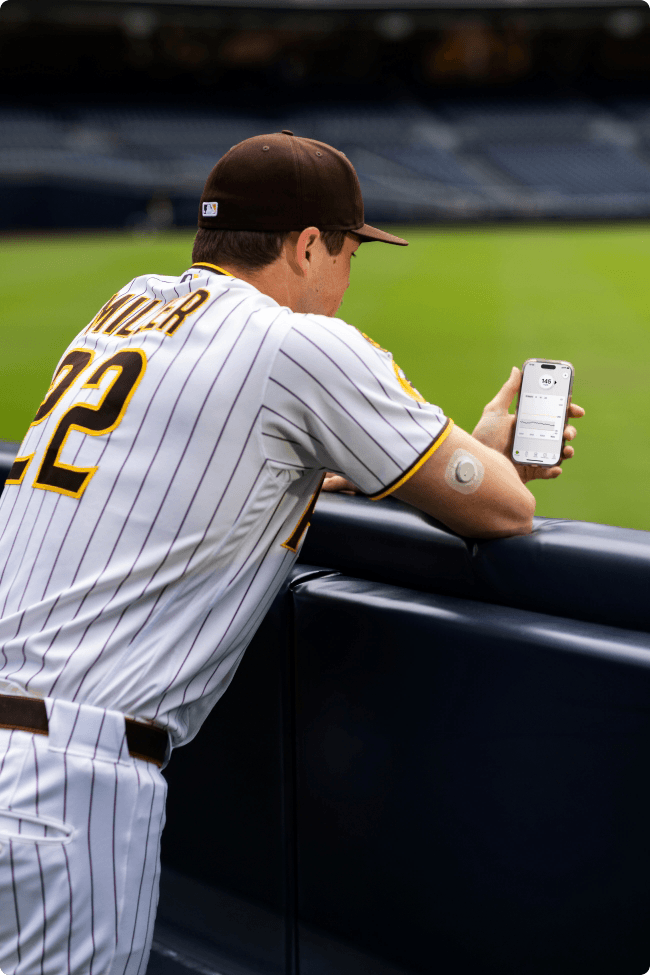
By Mason's side for every step of his transformation is his Dexcom CGM. Today, the tool he relies on most is Dexcom G7 15 Day.
"The Dexcom G7 15 Day sensor is an absolute game changer for my routine. It is the most accurate CGM1, and with a quick check on my phone†, I'm right where I need to be."
For a relief pitcher, the demands are unique. Unlike a starter who knows exactly when he's pitching, a closer lives in unpredictability. Every game, Mason arrives at the park not knowing whether he'll throw 30 pitches or none at all. His body — his glucose levels — has to be ready for anything, at any moment.
His pre-game routine centers on managing his blood sugar. He eats two hours before the game, timing his fast-acting insulin to peak before the game starts. He aims for a glucose level of 130–150 mg/dL—high enough to prevent lows during play, low enough to maintain focus.
"Part of having a Dexcom CGM is I can not only get high or low alerts, but also just put myself in the best position that I feel most comfortable in once I have to go compete."
Around the fourth or fifth inning, he heads to the bullpen. His Dexcom G7 15 Day receiver is with him — a reflex more than a ritual. "At any point, it's almost like a reflex to just pull it out, check it, see where you're at."
Adrenaline, he's learned, rockets his glucose. A reading of 140 mg/dL can surge to 250 mg/dL in twenty minutes of game time. That's not a problem — that's data. He knows it, he plans for it, and he uses it.
"I don't have to worry about my glucose levels when I'm pitching in a game because I've done all the preparation, I've done the necessary work, the necessary checks to know that I'm in a good spot, and that is freeing for sure."
With the G7 15 Day sensor, he also gains something invaluable for someone who travels constantly across time zones, altitudes, and climates: continuous, uninterrupted insight. Fifteen days of wear means fewer disruptions to his routine, fewer sensor changes during road trips, and more time thinking about baseball instead of logistics.
"With how much I travel, I really have a lot of different climates, different altitudes — things that I do think affect me. I'm able to make adjustments on the fly pretty quickly thanks to my Dexcom CGM, and being able to check in, look at the last 12 hours."
"It just becomes second nature because of how easy it is to access and how easy it is to use."
The Circle: Love, Support, and Shared Data
Mason doesn't manage Type 1 diabetes alone. Behind the locked-in competitor on the mound is a network of people who are always watching — sometimes literally.
His mother was the first in his corner — researching constantly, sending him articles, making sure he felt supported. His wife, Jordan, came into his life the year after his diagnosis and never once made him feel like it was a problem.
"She always supported me from day one, and it was like it was no big deal."
Jordan has had the Dexcom Follow app‡ on her phone for years. When an alert fires, Mason knows what's coming. "I know when I hear an alarm on my phone, it's probably 30 seconds later I'm going to get a text or a call from her — making sure everything's okay."
A 3 a.m. glucose alarm? Jordan has never once complained.
On the field, trainers also monitor Mason's Dexcom CGM data for their peace of mind — and his. Knowing that someone else has eyes on his numbers while he's locked in on the mound is one more layer of confidence in a high-stakes environment.
"I think it's easier for them to understand what I'm going through, and how different things are affecting me, without me having to verbalize it or explain it to them — they already know."
That's the quiet genius of the Share feature‡: it expands his circle of protection without requiring Mason to break focus.
The Mission: Paying It Forward
When Mason Miller takes the mound, the Friar faithful sees a hard-throwing reliever. What they may not see is the 20-year-old who sat in a hospital bed in Pittsburgh, terrified that baseball — and maybe much more — was over.
He remembers that kid.
After his diagnosis, Mason Googled athletes with Type 1 diabetes. The first name that came up was Mark Andrews — Baltimore Ravens tight end. Not a baseball player, but that didn't matter.
"I knew that if somebody can play in the NFL, then certainly I could go pitch in Division III at Waynesburg."
That small spark of hope mattered. Now Mason gets to be that spark for someone else. Like Mark Andrews, he's now a Dexcom Warrior.
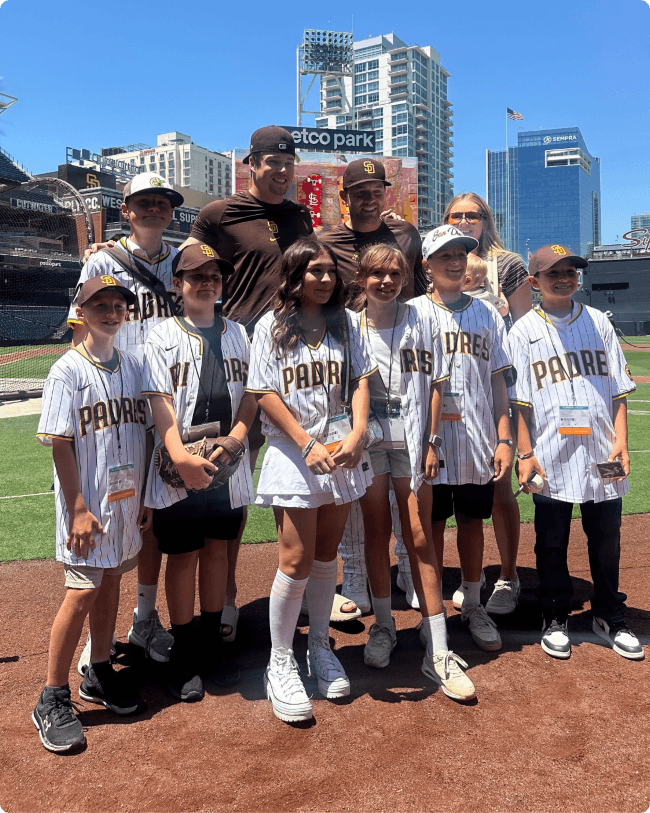
He has one-on-one meetups with young fans who have Type 1 — at the ballpark, during batting practice, on the field. He signs autographs, takes pictures, and at some point, they both show off their Dexcom CGM sensors.
"I tell all the kids I meet that the only limitations or the only restrictions that they'll have are the ones that they put on themselves. And I hope that they learn from me that living with Type 1 is a part of who we are, but it doesn't define us."
He also makes sure they know it goes both ways.
"I tell them, 'I know you're not going to believe this, but this is one of the coolest things for me too.' Having the ability to be a role model, to be an inspiration to kids — it really just is one of those opportunities that you get to take as a perspective check."
The dominant closer and the compassionate advocate are the same man — shaped by a diagnosis that nearly derailed everything, and powered by the technology, the community, and the refusal to accept limits.
"I had a choice: let diabetes take my dream or take absolute control over my life."
"Dexcom CGM was my glimmer of hope."
If You're Just Starting Out
Mason has one thing he wishes he could have told himself in that Pittsburgh hospital room, frightened and in the dark: "I would just tell myself it would be okay. People are going to support you. There are so many resources and so much technology — Dexcom being at the center of that — that allow you to live life to the fullest without having to worry or being held back by Type 1."
Type 1 diabetes didn't end Mason Miller's story. Through determination and the right tools, he learned day-by-day how to adapt and thrive.
Now, Mason’s story is a beacon for every kid who's ever sat in a hospital bed, Googling athletes with diabetes, looking for proof that their dream is still possible.
More Like This: Get Started on Dexcom G7
Read stories from more Dexcom Warriors like Mason who refused to let diabetes steal their dreams. Then take the next step for yourself and talk to your doctor about how Dexcom G7 might benefit you.
*Individual results may vary. †Compatible smart devices sold separately. To view a list of compatible devices, visit https://www.dexcom.com/compatibility ‡Separate Dexcom Follow app and internet connection required. Internet connectivity required for data sharing. Users should always confirm readings on the Dexcom G7 app or receiver before making treatment decisions. 1 Dexcom data on file, 2025